
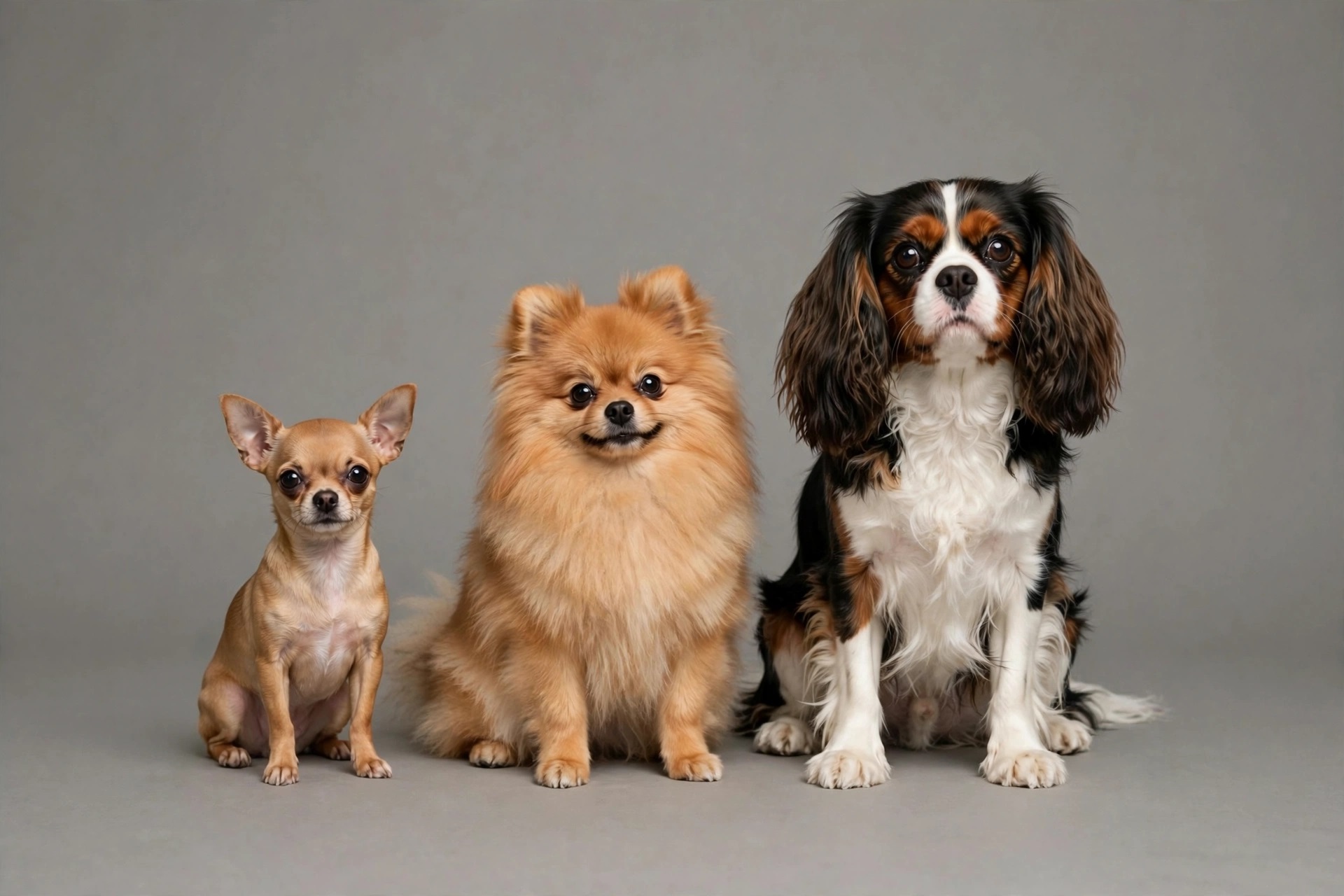
Scroll through small dog listings for ten minutes and you will see the same handful of words used in completely different ways. Teacup. Toy. Mini. Micro. Pocket. Imperial. One listing’s teacup is another listing’s mini, and a third describes the same weight range as simply small.
The confusion is not accidental, and it is not usually malicious either. It comes from the fact that exactly one of those words is an official classification and the rest are descriptive terms the market invented. Understanding the difference between teacup vs toy dog terminology is the single most useful thing you can do before buying a small breed puppy, because it changes what questions you ask and what answers actually tell you something.
Here is what each label genuinely means, which ones carry weight, and how to work out what size a specific puppy will actually be as an adult.
The Toy Group is a real, formal classification. Major kennel clubs organize breeds into groups, and the Toy Group is one of them. It contains breeds developed primarily as companions: the Chihuahua, Pomeranian, Maltese, Yorkshire Terrier, Papillon, Pug, Shih Tzu, Toy Poodle, Havanese and others.
When a dog is described as a toy breed, that means something specific and checkable. The breed belongs to that group, and the breed standard specifies a size range.
Teacup, mini, micro, pocket and imperial are not classifications. No kennel club registers a dog as a teacup. There is no teacup breed, no teacup standard, and no governing body that defines what weight qualifies. These are descriptive marketing terms, and their meaning shifts from seller to seller.
This is not an accusation. The words exist because buyers use them and because they do communicate something real, which is that a given puppy is expected to mature unusually small for its breed. The problem is only that the words carry no agreed definition, so they cannot be compared across listings.
A teacup Yorkie is still a Yorkshire Terrier. A teacup Pomeranian is still a Pomeranian. The word signals unusually small adult size within that breed, nothing more. Our guide to understanding the teacup Yorkie temperament walks through exactly how that plays out within one breed.
With the caveat that these are conventions rather than rules, here is roughly how the terms get used.
| Label | Typical adult weight | Official status | What it actually tells you |
| Toy | 4 to 12 lbs | Official kennel club group | The breed’s formal classification |
| Teacup | Under 4 to 5 lbs | Marketing term | Expected to mature very small |
| Micro or pocket | Under 3 to 4 lbs | Marketing term | Smaller still, highly variable |
| Mini or miniature | Varies hugely by breed | Mixed | Official for some breeds, marketing for others |
| Imperial | Under 8 to 9 lbs | Marketing term | Used mainly for Shih Tzu |
| Standard | Breed’s normal range | Descriptive | Within the written breed standard |
The “mini” row is where most of the genuine confusion lives, and it deserves its own explanation.
Miniature is an official size variety for some breeds and pure marketing for others, and the same word means wildly different things depending on which breed follows it.
Where miniature is official: The Poodle has three recognized varieties, Standard, Miniature and Toy, each with a defined height range. A Miniature Poodle is a specific thing. The Schnauzer, Dachshund and Pinscher similarly have miniature varieties that are formally recognized.
Where miniature is not official: A “miniature Golden Retriever” is not a recognized variety of Golden Retriever. It is typically a cross, often with a Poodle or a Cocker Spaniel. A “mini Labradoodle” is a Labrador crossed with a Miniature or Toy Poodle rather than a smaller version of a Labradoodle.
So when you see “mini,” the useful question is whether that breed has a recognized miniature variety. For a Poodle or a Schnauzer, mini is a real and checkable description with a defined size range. For most other breeds, mini tells you the puppy is expected to be smaller than typical, and the reason could be a cross, selective breeding for size, or simply that the puppy comes from small parents.
A mini Goldendoodle might be anywhere from fifteen to forty pounds depending on which generation and which Poodle size was used. That is an enormous range to have hidden behind one word.
This is the part that matters, and it has nothing to do with the label.
Ask about the parents. This is the single most predictive piece of information available. A puppy’s adult size correlates strongly with the size of its mother and father. Ask for both parents’ adult weights. A Yorkie puppy whose parents weigh five and six pounds will very likely mature in that range. The same puppy described as teacup, with parents weighing nine and ten pounds, is far less likely to stay tiny.
Ask about previous litters. If the same pairing has produced puppies before, their adult weights are excellent data.
Use current weight and age as a rough guide. For toy breeds, a common rule of thumb is to take the puppy’s weight at twelve weeks and roughly double it to estimate adult weight. For very small breeds, some use weight at six weeks multiplied by four. These are approximations with real error bars, not predictions, and they work less well the smaller the dog.
Look at the paws, loosely. Proportionally large feet on a young puppy often suggest more growth to come. This is folk wisdom rather than science, and it is weakly predictive at best, so treat it as one small signal among several.
Understand the growth timeline. Toy and small breeds finish growing much earlier than large breeds, typically reaching close to adult size between eight and twelve months. A large breed may keep growing to eighteen months or beyond. So a small breed puppy’s size at eight months is close to final.
| Age | Rough share of adult weight, toy breeds |
| 8 weeks | 20 to 25 percent |
| 12 weeks | 40 to 50 percent |
| 16 weeks | 55 to 65 percent |
| 6 months | 80 to 90 percent |
| 9 to 12 months | Essentially full size |
Treat this table as orientation rather than a calculator. Individual puppies vary, and the smaller the breed the wider the proportional variation.
The practical differences between a four-pound dog and a twelve-pound dog are larger than the eight-pound gap suggests, and worth thinking through before deciding which end of the range you want.
Fragility. Smaller dogs are physically more delicate. A jump off a sofa is a bigger proportional drop. Being stepped on, which is among the most common injury causes in very small dogs, carries more consequence. Households with young children or with large resident dogs need to weigh this honestly.
Supervision. The smaller the dog, the more the environment needs managing. Gaps in balcony railings, spaces behind appliances, and furniture heights all become real considerations rather than theoretical ones.
Feeding. Very small puppies need more frequent meals, typically three to four a day in the early months, because they have minimal reserves and fast metabolisms. This is a genuine scheduling commitment rather than a preference.
Temperature. Small bodies lose heat faster. In Boca Raton this mostly means air conditioning rather than winter, but a three-pound dog in a well-cooled condo often wants a light layer.
Portability. The genuine upside. A five-pound dog travels, fits in a carrier, suits a condo, and can be managed by someone who could not handle a large dog physically.
Lifespan. Small breeds generally live longer than large ones, often twelve to sixteen years. That is a long commitment and worth planning for.
For the day-to-day picture of living with a dog at the small end of the range, how to properly care for small dogs covers the practical routine in more detail.
The label on a listing tells you very little. These questions tell you a great deal.
Notice that none of these mention the word teacup. That is deliberate. A seller who can answer these specifically is giving you real information. A seller whose answer is simply that the puppy is a teacup is giving you a category rather than a fact.
Be reasonably skeptical of guarantees about final adult weight. Nobody can promise a puppy will stay under a given number, because growth is not fully predictable. A thoughtful answer sounds like a range with reasoning attached, not a precise figure stated with certainty.
Breeding for extreme smallness has limits, and a responsible conversation about very small dogs acknowledges them.
Dogs at the far small end of any breed’s range need more careful management than dogs in the middle of that range. More frequent meals, more attention to warmth, more care around furniture and foot traffic, and more vigilance generally. None of that makes them a poor choice. It makes them a choice that suits some households and not others.
The households where very small dogs do best tend to share a few features: adults or older children rather than toddlers, a willingness to manage the environment carefully, a schedule that allows frequent small meals in the early months, and realistic expectations about fragility.
If that describes your home, a tiny dog is a wonderful companion. If it does not, a dog at the standard end of a toy breed’s range gives you most of the same appeal with considerably less management. Our overview of teacup puppies covers what daily life with one actually looks like.
The practical summary:
Toy is the only official word in the list, and it describes a breed group rather than an individual dog’s size.
Teacup, micro, pocket and imperial are descriptive market terms with no agreed definition. They signal an expectation of unusual smallness and nothing verifiable beyond that.
Mini is official for some breeds, Poodles and Schnauzers among them, and marketing for others. Check which situation you are in.
Parent weights predict adult size better than any label on any listing.
Smaller means more management, not worse. Decide which end of the range suits your household honestly rather than aspirationally.
The teacup vs toy dog question has a short answer: toy is a real classification, teacup is a description. Neither tells you what a particular puppy will weigh at a year old, and only one of them is checkable against anything.
What tells you is the parents’ adult weights, the history of previous litters from the same pairing, and the puppy’s current weight at a known age. Ask those three questions and the labels stop mattering, because you will have the actual information the labels were standing in for.
Looking at small breed puppies in the Boca Raton area? The team at Waggs to Riches can show you parent information, current weights and realistic adult size estimates for the puppies we have, and give you a straight answer rather than a category. Come visit us, meet the puppies, and ask us the hard questions.
Is a teacup dog an actual breed?
No. There is no teacup breed and no kennel club registers a dog as a teacup. A teacup Yorkie is a Yorkshire Terrier, a teacup Pomeranian is a Pomeranian. The word is a descriptive market term indicating an expectation of unusually small adult size within that breed, and it has no agreed definition, so one seller’s teacup may be another’s mini.
What is the difference between a teacup and a toy dog?
Toy is an official kennel club classification describing a group of companion breeds, each with a written size standard, typically four to twelve pounds. Teacup is an unofficial descriptive term usually applied to dogs expected to mature under about four or five pounds. Toy is checkable against a breed standard. Teacup is not checkable against anything.
How can I predict how big my puppy will get?
Ask what both parents weigh as adults, which is the strongest predictor available, and ask about the adult weights of puppies from previous litters of the same pairing. As a rough secondary check for toy breeds, a puppy’s weight at twelve weeks roughly doubled approximates adult weight. Treat that as an estimate with real error rather than a prediction.
Does “mini” mean the same thing for every breed?
No, and this is the most confusing label of the group. Miniature is an official recognized variety for Poodles, Schnauzers, Dachshunds and Pinschers, each with a defined size range. For most other breeds, including mini Golden Retrievers and mini Labradoodles, it is a descriptive term usually indicating a cross or selective breeding for size, and the resulting range can be very wide.
At what age do small breed puppies stop growing?
Toy and small breeds typically reach close to adult size between eight and twelve months, much earlier than large breeds which may keep growing to eighteen months or beyond. By six months a small breed puppy is usually at eighty to ninety percent of adult weight, so size at that point is a reasonably good indicator of where they will finish.
Are very small dogs harder to care for?
They need more environment management rather than more difficulty as such. Frequent small meals in the early months, care around furniture heights and foot traffic, attention to gaps and openings in the home, and awareness that they chill more easily. Households with toddlers or large resident dogs should think carefully. For the right home, they are excellent and very manageable companions.
Should I trust a seller who guarantees a specific adult weight?
Be cautious. Growth is not fully predictable, and nobody can promise a precise final weight. A thoughtful seller gives you a range with reasoning behind it, based on parent weights and previous litters, and is clear that it is an estimate. A confident single number stated as a certainty is a reason to ask more questions rather than fewer.
Monday-Saturday 11-6
Sunday 12-4
Copyright © 2026 Waggs To Riches Pet Boutique. Developed by Wyne Technologies LLC .